
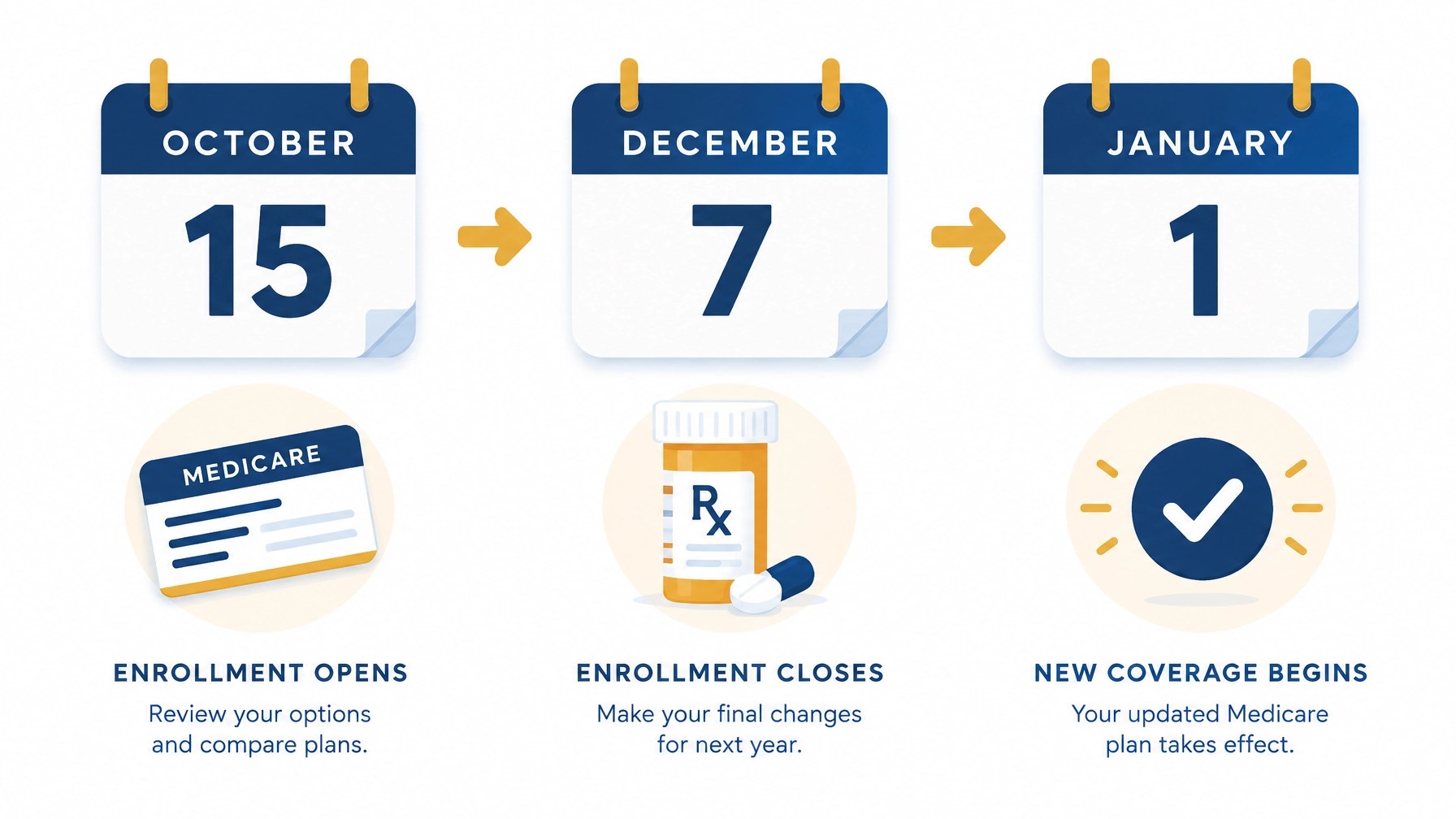
If you are reviewing Medicare coverage for 2027, now is the time to move from “I’ll look at it later” to a clear action plan. As of Monday, September 21, October 15 is only 24 days away—the first day of Medicare’s Annual Enrollment Period, also called the Open Enrollment Period.
From October 15 through December 7, 2026, you can join, switch, or drop a Medicare Advantage Plan or Medicare drug plan. If you make a change by December 7, your new coverage generally begins January 1, 2027.
First, understand the 2026 changes you need to carry into your 2027 review
Medicare Advantage and Part D rules continue to evolve. The key is not to memorize every regulation. Instead, know which changes could affect your care, prescriptions, and household budget.
Prior authorization protections: In 2026, Medicare Advantage plans face stronger limits on reopening an approved inpatient hospital admission. In general, a plan may only reopen that decision because of obvious error or fraud. This protection matters because it can reduce the risk of a previously approved stay being retroactively changed after treatment has already occurred.
You may still need prior authorization for certain services, drugs, or procedures. However, an approval should carry meaningful weight. The CMS 2026 Medicare Advantage and Part D policy update explains these changes.
Supplemental benefit guardrails: Medicare Advantage plans may continue offering benefits such as dental, vision, hearing, fitness, transportation, and certain over-the-counter support. However, CMS has clarified that some items cannot be offered as supplemental benefits, including life insurance, funeral expenses, alcohol, tobacco, and certain non-health-related products.
For 2027, pay close attention to how special supplemental benefits for the chronically ill, or SSBCI, work. Plans must publicly post eligibility criteria, and benefit cards must use real-time verification for covered purchases. Balances are also limited to the specific plan year rather than automatically rolling forward. In practical terms, do not assume that a benefit card’s advertised dollar amount is available for every item or every member. Review the eligibility rules and expiration dates carefully. The CMS 2027 Medicare Advantage and Part D final rule provides additional detail.
Part D out-of-pocket changes: Covered prescription drug spending has a separate annual limit from your Medicare Advantage medical maximum.
- In 2026, covered Part D drug costs are capped at $2,100.
- In 2027, the cap rises to $2,400.
- The maximum standard Part D deductible rises from $615 in 2026 to $700 in 2027.
- After you reach the $2,400 limit in 2027, you pay $0 for covered Part D drugs for the rest of the calendar year.
As the official Medicare & You 2027 handbook puts it: “In 2027, your out-of-pocket costs for covered drugs are capped at $2,400.”
That cap can provide important protection, but it does not make every plan equally affordable. Your premium, formulary, pharmacy network, deductible, and drug tiers still matter.
The Part D Premium Stabilization Demonstration ends: CMS plans to discontinue the temporary Part D Premium Stabilization Demonstration after the 2026 plan year. The program will not continue into 2027. CMS has described the change as a return to “traditional market conditions” for Part D plans.
For 2027, CMS set the national base beneficiary premium at $41.33, compared with $38.99 in 2026. Your actual plan premium may be higher or lower. The national average monthly bid amount is $296.05, but plan-specific costs depend on where you live and which coverage you choose. Consequently, your Annual Notice of Change and 2027 plan details deserve a careful review.
Medicare Advantage payment and maximum out-of-pocket context: CMS projects average Medicare Advantage payments to plans will increase by approximately 2.48% in 2027, or more than $13 billion compared with 2026. That figure is about plan payments, not a promise that your premium or benefits will improve.
CMS also sets annual federal ceilings for Medicare Advantage medical out-of-pocket costs:
- 2026: Up to $9,250 in-network or $13,900 combined in- and out-of-network for covered Part A and Part B services.
- 2027: Up to $9,850 in-network or $14,800 combined in- and out-of-network.
Individual plans may set lower limits. These maximums generally do not include Part D drug costs, which follow the separate prescription cap. The CMS 2027 rate announcement offers additional program-level context.
Medigap decisions require a different kind of countdown
The October 15–December 7 enrollment window is important for Medicare Advantage and Part D, but it does not automatically create a new six-month Medigap Open Enrollment Period.
Medicare Supplement Insurance, or Medigap, works with Original Medicare. It helps pay certain deductibles, copayments, and coinsurance. You cannot use Medigap with a Medicare Advantage Plan.
Standardized letter plans: In most states, including New York State, Medigap policies are standardized by letter. That means Plan G benefits are generally the same from one insurer to another, and Plan N benefits are generally the same from one insurer to another. Premiums, customer service, household discounts, and pricing can still differ.
Plan G compared with Plan N:
- Plan G generally covers nearly all Medicare-approved Part A and Part B cost sharing after you pay the annual Part B deductible. It also covers Part B excess charges where applicable.
- Plan N generally covers Part A cost sharing and Part B coinsurance, but you may pay up to $20 for some office visits and up to $50 for certain emergency room visits when you are not admitted. Plan N does not cover Part B excess charges.
Plan G may offer more predictable costs, while Plan N may have a lower premium with more point-of-service cost sharing. The better fit depends on how often you see providers, where you receive care, and how comfortable you are with occasional copayments.
Your six-month Medigap Open Enrollment Period: This period begins when you are 65 or older and enrolled in Medicare Part B. During this window, you generally have stronger protections and can buy a Medigap policy without medical underwriting.
Outside that period, an insurer may ask health questions, review your medical history, decline your application, or charge more, unless you qualify for a guaranteed-issue right or another special protection. State rules can add protections, so your rights may differ in Florida, Georgia, Texas, Tennessee, North Carolina, South Carolina, Virginia, and New York State.
How Medigap premiums are priced: Insurers commonly use one of three methods:
- Community-rated: People in a pricing area generally pay the same premium regardless of age, although premiums can change for inflation or other approved reasons.
- Issue-age-rated: Your premium is based on your age when you buy the policy. Buying younger may result in a lower starting premium.
- Attained-age-rated: Your premium is based on your current age and may rise as you get older.
To compare official plan benefits and pricing information, visit Medicare.gov’s Medigap resources. Super Senior Services can also help you evaluate the long-term financial effect of Plan G, Plan N, or another option.
Your five-step October 15 action plan
1. Confirm your Medicare foundation
Before comparing plans, confirm whether you have Medicare Part A and Part B. If you are approaching Medicare eligibility and are not automatically enrolled, review the enrollment information at SSA.gov.
Also identify any other coverage you have, such as employer, retiree, union, Veterans Affairs, or TRICARE coverage. If you have creditable prescription drug coverage, keep the documentation. “Creditable coverage” means coverage expected to pay, on average, at least as much as standard Medicare drug coverage.
2. Read your Annual Notice of Change
Your current Medicare Advantage or Part D plan should send an Annual Notice of Change by September 30. It explains changes taking effect in January, including:
- Premiums and deductibles
- Copayments and coinsurance
- Provider networks
- Drug formularies, or covered drug lists
- Pharmacy rules
- Supplemental benefits
- Service area changes
- Maximum out-of-pocket amounts
Do not judge your plan only by whether the premium remains $0. A $0-premium plan can still have higher specialist copayments, a narrower network, or a formulary change that raises your prescription costs.
3. Build your medication and provider checklist
Write down every prescription, dosage, frequency, and preferred pharmacy. Include medications filled only a few times each year. Then confirm whether each drug is on the plan’s formulary, which tier it occupies, and whether prior authorization, step therapy, or quantity limits apply.
Create a provider list, too. Include your primary care doctor, specialists, preferred hospital, laboratory, pharmacy, and durable medical equipment suppliers. A plan that saves $25 per month may not be a savings if it disrupts access to an important doctor or costs significantly more for your prescriptions.

4. Compare total annual costs, not just premiums
Use a side-by-side worksheet for your current plan and each alternative. Estimate:
- Annual premiums, including Part B and any plan premium
- Drug deductibles and expected prescription spending
- Primary care and specialist copayments
- Hospital and outpatient coinsurance
- Your medical maximum out-of-pocket limit
- Dental, vision, hearing, transportation, or over-the-counter costs
- Travel and out-of-network rules
- Potential costs if your prescriptions reach the Part D cap
For example, a plan with a $15 monthly premium costs $180 per year before medical or drug expenses. A plan with a $0 premium may still cost more if you regularly use specialists or take high-tier medications.
You can begin comparing options through Medicare.gov Plan Compare. A personalized review can make the numbers easier to understand.
5. Enroll or change coverage between October 15 and December 7
Once you have compared the complete picture, submit your enrollment or plan change during the Annual Enrollment Period. Your new coverage should take effect January 1, 2027, when the plan receives your request by December 7.
Save your confirmation number, enrollment date, plan materials, and medication list. Then check your new member card and January coverage details. If you remain in the same plan, review the new Evidence of Coverage anyway: renewal does not always mean identical benefits.

Get a Medicare review built around your life
Medicare decisions are personal. Your prescriptions, doctors, travel plans, budget, health conditions, and comfort with cost-sharing all matter.
Super Senior Services provides personalized Medicare plan reviews and year-round support for residents of Florida, Georgia, Texas, Tennessee, North Carolina, South Carolina, Virginia, and New York State. We simplify comparisons, explain premiums and formularies, review Medicare Advantage and Medigap options, and schedule annual reviews so your coverage stays aligned with changing needs.
Start your 2027 review at superseniorservices.com/medplans, or contact Stephen Jackson for personalized guidance before October 15.
Compliance note: Individual NPN: Stephen Jackson 20707378; Corporate NPN: Super Senior Services 21536694.
WordPress category: medicare