
Leaving an employer can feel exciting and uncertain at the same time, especially when your health insurance disappears with your last paycheck.
Whether you are now freelancing, working on 1099 contracts, driving for a gig platform, or building a new business in New York, you have options. The key is moving quickly, estimating your income carefully, and comparing coverage based on your actual healthcare needs, not just the lowest monthly premium.
Here is how to replace the group coverage you just left through NY State of Health.
First, confirm that you have a qualifying life event
Losing employer-sponsored health insurance generally creates a Qualifying Life Event (QLE) and opens a Special Enrollment Period (SEP) for individual coverage.
The event is usually the loss of coverage, not simply becoming self-employed. Common examples include:
- Leaving a job where you had health insurance, including quitting in situations where your coverage ends
- Being laid off or terminated
- Having your work hours reduced so you are no longer eligible for the employer plan
- Losing coverage because an employer stops offering the plan
- Reaching the end of an employer plan or another group plan
- Losing coverage after a business closes or your employment status changes
HealthCare.gov explains:
“You may qualify for a Special Enrollment Period if you or anyone in your household lost qualifying health coverage in the past 60 days OR expects to lose coverage in the next 60 days.”
New York uses its own state Marketplace, but this basic loss-of-coverage principle applies when you apply through NY State of Health. Review the state’s Special Enrollment Period information, then confirm your specific eligibility.
Why this matters: You may not have to wait for annual Open Enrollment. You can use your SEP to compare a Qualified Health Plan (QHP), check for premium tax credits, and potentially lower your out-of-pocket costs.
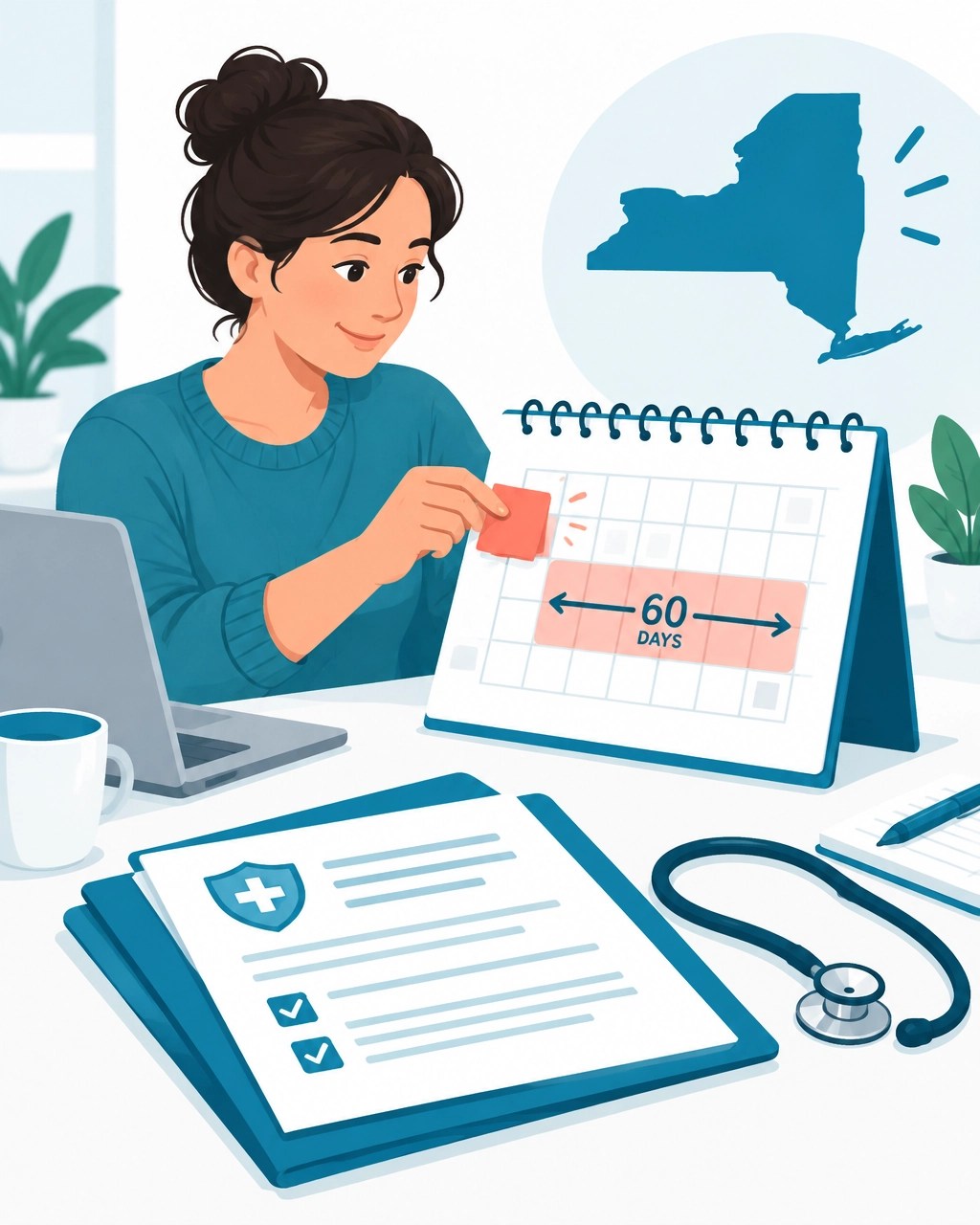
Calendar your 60-day enrollment window immediately
Your loss-of-coverage date is the date your old employer plan actually ends. It may not be the same as your last day at work.
Typically, you can apply and enroll:
- Up to 60 days before your employer coverage ends, if you know the end date in advance
- Within 60 days after the coverage loss
For example, if your employer insurance ends on June 30, your SEP generally runs around that coverage-loss date, not the day you first stop working. Write down June 30, save your notices, and calendar the final enrollment deadline.
You may need to submit proof of the event. Useful documents can include:
- A letter from your employer showing your final day of coverage
- A termination or eligibility notice from the insurance carrier
- A COBRA election notice listing the prior plan and coverage end date
- A benefits statement showing when coverage stopped
- Documentation showing that your work hours dropped below the plan’s eligibility threshold
Do not wait until the deadline to gather documents. A missing date or unclear notice can delay eligibility verification.
Your next step: Confirm the exact coverage end date, apply through NY State of Health, and keep copies of every document you submit.
COBRA is an option, not an automatic requirement
COBRA lets you continue your former employer’s group health plan for a limited time. It may be valuable if you are in the middle of treatment, need to keep the same doctors, or have already met much of your annual deductible.
However, COBRA can be expensive because you may pay the full group premium plus an administrative fee. The employer may no longer contribute toward your monthly cost.
A short comparison can help:
| Option | Main advantage | Main concern |
|---|---|---|
| COBRA | Keeps your existing plan, network, and benefits | You may pay the entire premium |
| Qualified Health Plan | May offer premium tax credits and a broader choice of individual plans | Networks, formularies, deductibles, and drug costs may differ |
| Essential Plan | Year-round enrollment and low-cost coverage for eligible New Yorkers | Income and other eligibility requirements apply |
Here is the important timing trap: Losing your employer coverage creates the original Marketplace SEP whether or not COBRA is offered. But while you are enrolled in COBRA, you generally cannot receive Marketplace premium tax credits for the same period.
Additionally, if you voluntarily cancel COBRA after your original SEP has ended, that cancellation generally does not create a new SEP. In practical terms, choosing COBRA without comparing your Marketplace options first can leave you paying more and potentially outside the easiest path to subsidized coverage.
That does not mean COBRA is always the wrong answer. It means you should compare:
- Monthly premium
- Deductible and coinsurance
- Maximum out-of-pocket limit
- Current doctors and hospitals
- Prescription drug formulary
- Whether you qualify for financial assistance through NY State of Health
- How long you expect your income and healthcare needs to remain uncertain
Need help weighing the options? Contact Stephen Jackson before you make an election you may not be able to change easily.
Report 1099 income as estimated net income, not gross revenue
Self-employment income can change from month to month, but NY State of Health still needs your best estimate of annual household income.
For a self-employed applicant, that generally means projecting net business income:
Business revenue – allowable business expenses = estimated net self-employment income
If you receive $6,000 in 1099 payments but spend $1,500 on ordinary business expenses, your projected business income is not simply $6,000. Your estimate should reflect your expected net profit, along with other household income that may count for Marketplace eligibility.
Consider tracking:
- 1099 payments and other business revenue
- Business mileage and supplies
- Software, advertising, and professional expenses
- Estimated quarterly tax payments
- Spouse or household income, if applicable
- Expected business growth or seasonal slowdowns
Do not use last year’s income automatically if your situation has changed. A newly self-employed person may earn much more, or much less, than they did as an employee.
The amount you report helps determine your eligibility for:
- Premium tax credits, which reduce your monthly premium
- Cost-sharing reductions (CSRs), which can lower deductibles, copayments, and coinsurance
- Medicaid or the Essential Plan, depending on household income and other factors
If your income changes materially, update your NY State of Health application within 30 days. Reporting promptly can help you avoid receiving too much financial assistance and facing an unpleasant tax bill later.

Understand tax reconciliation before you accept the largest subsidy
Premium tax credits are often applied in advance. That lowers the amount you pay each month, but the final credit is based on your actual household income for the year.
At tax time, you will generally use:
- Form 1095-A, your Marketplace Health Insurance Statement
- Form 8962, Premium Tax Credit
The IRS states that Form 8962 is used to:
“Figure the amount of your Premium Tax Credit (PTC)” and “Reconcile it with any advance payments of the Premium Tax Credit (APTC).”
If your actual income is higher than your estimate, you may have received too much advance credit and could owe some of it back. If your actual income is lower, you may qualify for additional credit when you file.
You can read the IRS guidance on Form 8962, review Form 1095-A information, and use the HealthCare.gov premium tax credit guide.
A practical approach is to create a low, middle, and high income estimate. If your income is especially unpredictable, you may choose not to use the entire available advance credit each month. That can mean a higher monthly premium now, but it may reduce the chance of a large repayment later.
The Essential Plan may be available year-round
As of 2026, New York’s Essential Plan remains open for enrollment throughout the year for eligible residents. Following the 2026 eligibility changes, the income limit is generally at or below 200% of the federal poverty level.
For a one-person household, that is approximately $31,920 per year under the 2026 figures, although eligibility also depends on household circumstances and the current NY State of Health application rules.
The Essential Plan can be attractive because it may offer:
- $0 monthly premiums for eligible enrollees
- Low copayments
- Reduced out-of-pocket costs
- Year-round enrollment
Review the current requirements through the NY State of Health Essential Plan page. If your income later rises above the program limit, report the change within 30 days so your coverage can be evaluated for a Qualified Health Plan or another available program.
A Silver plan may be better than a cheaper Bronze plan
Qualified Health Plans are grouped into metal levels:
- Bronze: Usually lower premiums and higher costs when you receive care
- Silver: Moderate premiums and cost-sharing; the only metal level that can include CSRs
- Gold: Usually higher premiums and lower costs when you use services
- Platinum: Generally the highest premiums and lowest cost-sharing
A Bronze plan can look like the obvious choice when you are watching every dollar. But if you qualify for cost-sharing reductions, a Silver plan may provide a much lower deductible, copayment, or coinsurance amount.
For example, a Silver plan with a $10,000 deductible may be less useful to you than a CSR-enhanced Silver plan with a substantially lower deductible, even if the second plan’s monthly premium is slightly higher.
Compare the entire cost structure:
- Premium
- Deductible
- Primary care and specialist copays
- Emergency room and hospital coinsurance
- Prescription costs
- Maximum out-of-pocket limit
- Provider network
- Drug formulary
A plan is only affordable if you can use it when you need care. Super Senior Services can simplify this comparison through a personalized benefits review.

Plan now for 2027 income and enrollment
If your new business will continue into 2027, begin estimating next year’s income before Open Enrollment begins.
New York’s 2027 Qualified Health Plan Open Enrollment window is scheduled for:
- November 1, 2026 through January 31, 2027
- Enroll by December 15, 2026 for coverage beginning January 1, 2027
Use your 2026 records to build a realistic 2027 estimate, but do not simply copy your current number. Ask:
- Will you add clients or contracts?
- Are your expenses expected to increase?
- Is your work seasonal?
- Will you hire employees?
- Will you continue quarterly estimated tax payments?
- Do you expect a major change in household income?
If you become eligible for the Essential Plan, Medicaid, or another program, you may not need to wait for QHP Open Enrollment. Otherwise, calendar the dates now.
If you hire employees, consider small group coverage
Your coverage needs may change once your business has employees.
If you are a sole proprietor with no eligible employees, individual coverage may be the appropriate market for you. But if your New York business has eligible employees, an individual plan is not a substitute for evaluating small group coverage.
New York employers may explore the NY State of Health Small Business Marketplace or plans available through the New York small group market. Group coverage can help you offer benefits to employees, structure employer contributions, and evaluate whether your business may qualify for a small business health care tax credit.
The rules depend on your employee count, employee eligibility, contribution structure, and business setup. Before selecting coverage, review both the individual and small group possibilities.
Your self-employed coverage checklist
Before you enroll, save this list:
- Document the exact date your employer coverage ended
- Gather proof of loss, such as an employer letter or carrier notice
- Confirm whether COBRA was offered and calculate its full monthly cost
- Project your 2026 net self-employment income
- Include other household income when appropriate
- Note your quarterly tax payments and business expenses
- Check doctors, hospitals, pharmacies, and prescription formularies
- Compare Bronze, Silver, Gold, and CSR-enhanced Silver plans
- Decide between COBRA, a Qualified Health Plan, and the Essential Plan
- Report income or household changes within 30 days
- Calendar your 60-day SEP deadline
- Begin 2027 income planning before November 1, 2026
- Contact an advisor if you are adding employees and may need small group coverage
You do not have to figure this out alone. Contact Stephen Jackson at Super Senior Services for personalized guidance comparing New York coverage options, costs, networks, and enrollment timing.
Compliance note: Individual NPN: Stephen Jackson: 20707378. Corporate NPN: Super Senior Services: 21536694.