
Category: businesshealth
If your New York small business health plan renews on January 1, 2027, September is the right time to begin: not the time to wait for a renewal packet and hope the numbers work.
Your renewal decision affects your employees’ premiums, deductibles, provider access, prescription coverage, and your company’s budget for the year ahead. By starting early, you have time to review utilization, compare carriers, confirm eligibility for cost-saving programs, and choose an employer contribution strategy that supports both your team and your financial stability.
Super Senior Services helps New York business owners simplify this process with a personalized benefits review, clear plan comparisons, and guidance from preparation through enrollment.
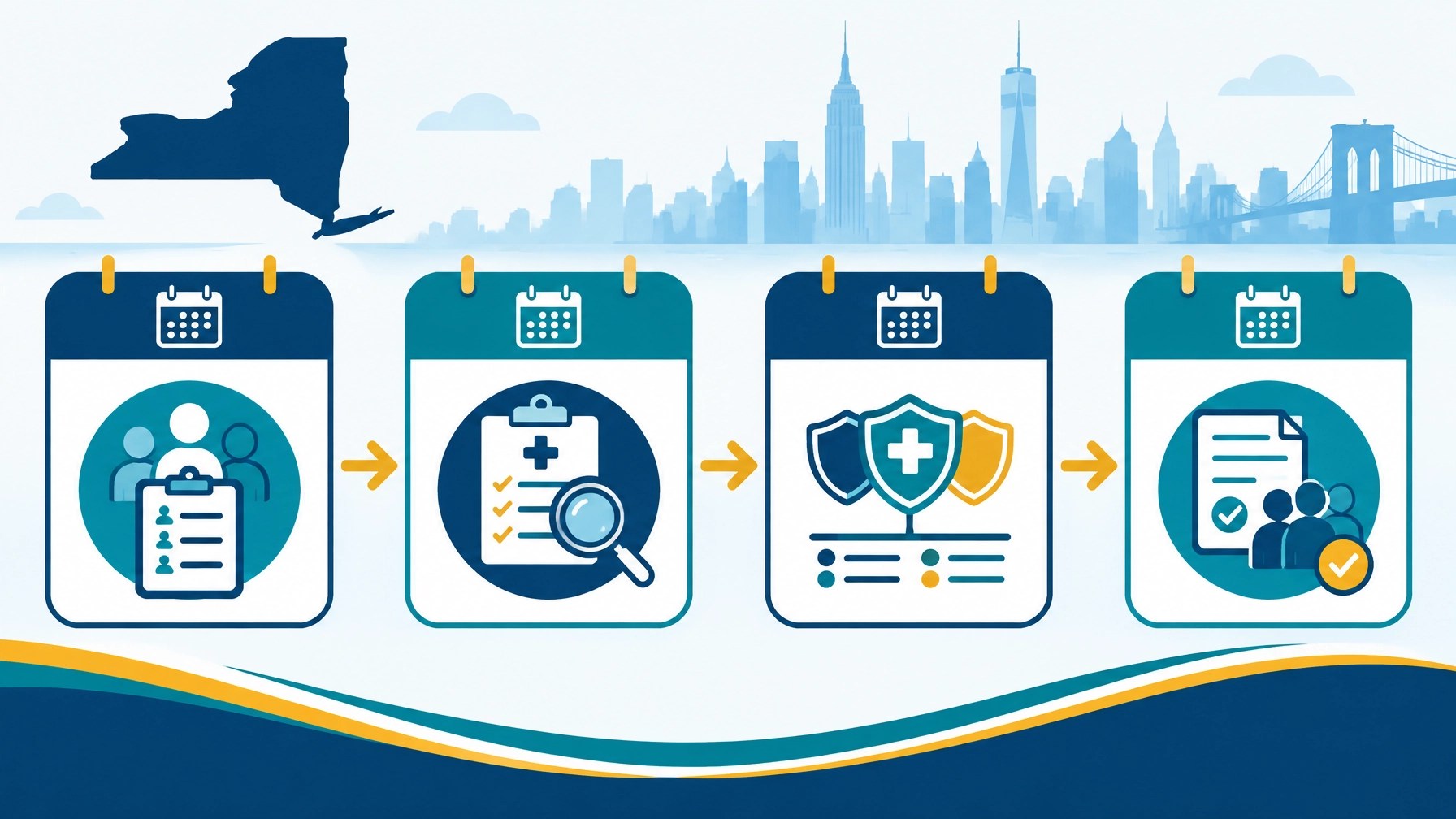
Here is your practical September-to-December timeline.
September: Gather your renewal information
Start by confirming your current plan’s renewal date, renewal type, and required deadlines. Although many New York small-group plans renew January 1, your plan may renew on another anniversary date. Insurers generally provide renewal and recertification materials 60 to 90 days before renewal; Healthy NY recertification materials are generally provided at least 90 days in advance.
You should also review New York’s 2027 renewal-rate notification guidance and ask your broker or carrier which documents apply to your group.
Create an updated employee census containing:
- Employee names and coverage status
- Full-time, part-time, seasonal, or variable-hour classification
- Hours worked
- Hire dates and eligibility dates
- Employee-only, employee-plus-dependent, or family coverage
- Waivers and reasons for declining coverage
- Dependents enrolled, where applicable
- Current employee and employer premium contributions
- Estimated 2027 enrollment changes
Keep the census accurate and secure. A small data error: such as a terminated employee remaining on the list or an incorrect coverage tier: can affect rates, eligibility, participation, and payroll deductions.
Next, review your current plan’s performance. Look beyond the monthly premium and examine:
- Deductibles and copayments
- Coinsurance, meaning the percentage of a covered expense the member pays after meeting the deductible
- Out-of-pocket maximums
- Provider networks and local hospital access
- Prescription formularies, or the lists of covered medications
- Employee feedback about access, referrals, and claims
- Employer and employee premium increases
- Utilization trends using aggregate information, not individual medical details
You do not need to know every employee’s diagnosis to make a smart renewal decision. You need a clear picture of what your plan costs and how well it supports your workforce.
October: Compare carriers and check New York savings programs
Once your information is organized, compare your current plan with available New York small-group alternatives. An apples-to-apples comparison should show the total premium, employer contribution, employee payroll deduction, deductible, coinsurance, out-of-pocket maximum, network, formulary, and coverage tiers side by side.
A plan with the lowest premium is not always the most affordable choice. For example, reducing the monthly premium by $40 may not benefit an employee if the new plan has a $1,500 higher deductible or excludes a commonly used hospital system.
This is also the month to investigate eligibility for programs that may reduce your net cost.
Review Healthy NY eligibility
Healthy NY is a New York program designed for qualifying small employers. Current 2026 guidance generally includes requirements such as:
- The business is located in New York
- The employer has 1–50 full-time equivalent employees
- At least 30% of eligible employees earn no more than the applicable wage threshold
- The business meets prior-coverage requirements
- Coverage is offered to qualifying employees who work at least 20 hours per week
- Participation and employer contribution rules are satisfied
For 2026, the Healthy NY wage threshold is $55,260, but the threshold is adjusted annually. Do not assume the 2027 amount will be identical. Review the latest information from the New York Department of Financial Services Healthy NY program before relying on a specific figure.
Check NY State of Health SHOP tax credit eligibility
The federal Small Business Health Care Tax Credit may be available to qualifying employers that purchase coverage through the SHOP Marketplace. According to HealthCare.gov, the primary requirements generally include:
- Fewer than 25 full-time equivalent employees
- Average employee wages of approximately $65,000 per year or less, subject to applicable annual adjustments
- Employer payment of at least 50% of employee-only premium costs
- An offer of SHOP coverage to all full-time employees
The maximum credit can be up to 50% of eligible employer premium contributions for a for-profit business, or up to 35% for a qualifying tax-exempt employer. The credit generally applies for two consecutive taxable years, and the exact amount depends on factors such as FTE count and average wages.
As the IRS explains, “If you are a small employer, there is a tax credit that can put money in your pocket.”
Eligibility is detail-sensitive. Your FTE calculation, wage calculation, employer contribution, and marketplace enrollment all matter. Super Senior Services can help you organize the information before you make a carrier or funding decision.
November: Lock in your contribution and funding strategy
By November, you should have enough information to decide how much your business will contribute toward employee coverage.
A common approach is to contribute a fixed percentage of the employee-only premium. For example, if employee-only coverage costs $700 per month and your company contributes 50%, the employer contribution would be $350 per month, before considering dependent coverage. Another approach is a defined dollar contribution, which can make budgeting easier but may shift more of a future rate increase to employees.
Compare at least three budget scenarios:
- Current contribution with the renewed plan
- Increased employer contribution with a lower-cost plan
- A defined employer contribution paired with multiple plan options
Your goal is not simply to reduce the company’s premium. It is to create a sustainable strategy that employees can afford and understand.
Consider a Section 125 plan
A Section 125 cafeteria plan can allow employees to pay their share of eligible group health premiums through pre-tax payroll deductions. This may reduce employees’ federal taxable income and may also reduce the employer’s FICA costs.
If you use Section 125, make sure the plan document, payroll setup, employee elections, and deduction codes are handled correctly before deductions begin. Do not make retroactive changes casually. Coordinate with your payroll provider, benefits administrator, or tax professional.
Consider an ICHRA
An Individual Coverage Health Reimbursement Arrangement, or ICHRA, is an employer-funded benefit that reimburses eligible employees for individual health coverage and other qualified medical expenses. It can offer predictable employer spending and give employees more individual plan flexibility.
However, an ICHRA is not simply a group plan with a different name. You must establish eligible employee classes, set the allowance properly, provide required notices, and ensure employees maintain qualifying individual coverage. You generally cannot offer a traditional group plan and an ICHRA to the same employee class at the same time.
If you are considering an ICHRA for January 1, 2027, coordinate your decision with NY State of Health enrollment timing. Employees may need to select or renew individual coverage during the applicable open enrollment period to avoid a coverage gap.
Do not assume Section 125 can be used to fund the ICHRA itself or to make every individual-market premium pre-tax. Confirm the arrangement with a qualified tax or benefits professional.
Review participation rules and the November 15–December 15 window
Some carriers apply minimum participation requirements, often based on the percentage of eligible employees who enroll or have valid alternative coverage. If you expect low participation, ask whether New York’s annual November 15–December 15 small-group enrollment window affects your options.
The window may be especially important for a January 1 effective date when employees have other coverage or when participation is uncertain. Requirements can vary by carrier and product, so confirm the dates and application rules before relying on them.
If your group is close to a deadline, personalized guidance can help you avoid an expensive last-minute decision.

December: Finalize enrollment and communicate clearly
December is for execution. By now, you should have selected the plan or funding approach, confirmed the employer contribution, and prepared employee communications.
Before the effective date, complete the following:
- Sign carrier or marketplace documents
- Submit the final employee census
- Confirm eligible employees and dependents
- Collect waivers and enrollment elections
- Verify payroll deductions
- Confirm employer contribution amounts
- Review member ID card timing
- Share provider-network and formulary information
- Explain deductibles, coinsurance, copayments, and out-of-pocket limits
- Provide employees with clear enrollment deadlines
A short employee meeting can prevent confusion. Explain what the company pays, what the employee pays, how dependent coverage works, and where employees can ask questions.
If you are renewing Healthy NY coverage, complete the required recertification accurately. If you are applying for a SHOP tax credit, retain wage, FTE, premium, and enrollment records for your tax professional.
Set up your 2027 annual review now
Your renewal process should not begin and end with one annual deadline. Schedule a benefits review at least 90 days before your next renewal date and establish a simple quarterly check-in.
Track:
- Enrollment changes
- Employer and employee premium costs
- Employee feedback
- Network or formulary changes
- Participation levels
- Payroll deduction accuracy
- Eligibility for Healthy NY or SHOP savings
- Whether your contribution strategy remains affordable

Make your 2027 renewal easier
New York small business health insurance decisions involve more than comparing monthly premiums. You need to evaluate plan design, employee affordability, participation, tax opportunities, payroll administration, and long-term sustainability.
Super Senior Services simplifies the process with a comprehensive benefits review and personalized carrier comparisons for New York businesses. We help you understand your choices, identify potential savings, and move forward with greater confidence.
Contact Super Senior Services to begin your New York 2027 renewal review.
Compliance note: Individual NPN : Stephen Jackson: 20707378. Corporate NPN : Super Senior Services: 21536694.